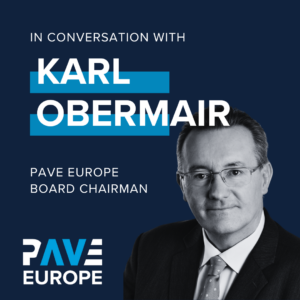
As Karl Obermair steps down from his role as Chairman of PAVE Europe, we wanted to take a moment to look back at the organisation’s growth, the progress made in fostering constructive dialogue on automated mobility, and the lessons learned along the way. As the association’s first chairman, he reflects on the milestones that shaped PAVE Europe from its inception and shares his thoughts on the road ahead for automated mobility in Europe.
In your view, what has changed most significantly in the European AV landscape over the last few years?
Europe has learned that automated mobility is no longer a distant, science-fiction concept but an emerging reality that is already reshaping our society. This disruption will change the way we move, the way we produce, and how we live together in both cities and rural areas. And when I say “we”, I really mean all of us – children, older people, the wealthy, poorer communities, and those who live with disabilities.
Which accomplishments during your chairmanship make you feel the most proud, and why?
We started PAVE Europe a few years ago as nothing more than an idea, drafted by four people during a single call. (And, by the way, all four of them are still actively involved with PAVE Europe today in various roles). We convinced others to join us and to invest – or, in other words, to trust in the idea and its potential. I believe it was Victor Hugo who said, “Nothing is as powerful as an idea becoming a reality at the right time”.
Where do you see the biggest unrealised opportunities for automated mobility in Europe?
Europe is one of the richest regions in the world, with enormous financial resources. Yet, we still see a shortage of venture capital and a lack of both private and public investment in automated mobility. There are many reasons for this more cautious European mindset – some good, some trust – but risk avoidance remains a very typical European habit.
If you look ten years ahead, what would you most like to see accomplished in the field you’ve helped shape?
I am convinced that automated mobility will become a fully integrated part of our daily routines. When I was a child, I received one of the first handheld calculators as a gift, and most people were convinced that this technology would never work. Four years later, it was mandatory for school kids over the age of ten to use these devices every day. The same pattern repeated itself with photocopiers, fax machines, the internet and mobile phones. Not every innovation becomes a disruption, of course – but when disruption does occur, it is often because the right idea appeared at exactly the right moment.
As you step into the next chapter, what message would you like to share with the PAVE Europe community and the wider AV ecosystem?
My message is this: always begin with the end in mind! Don’t spend too much time thinking primarily about obstacles or problems that need solving on the way to the goal. Have confidence that you will cross each bridge when you reach it.
“Karl has played a foundational role in shaping PAVE Europe into the association it is today. His commitment to clarity, integrity and open dialogue has set a strong standard for our work and our mission. On behalf of our members and the entire team, I want to express my gratitude for his leadership and his vision. We wish him every success in the next chapter and look forward to building on the legacy he leaves behind.”
Guido Di Pasquale, Managing Director, PAVE Europe
About PAVE Europe
Partners for Automated Vehicle Education (PAVE) Europe is a non-profit coalition that seeks to raise the level of public knowledge of automated vehicle technology and the potential benefits for safety, mobility, equity, and congestion. PAVE Europe’s diverse membership includes international corporations, start-ups, consumer advocates, nonprofit groups, and other stakeholders. PAVE Europe seeks to educate and facilitate dialogue among industry, policymakers, and the public to advance the development and deployment of AV technology.