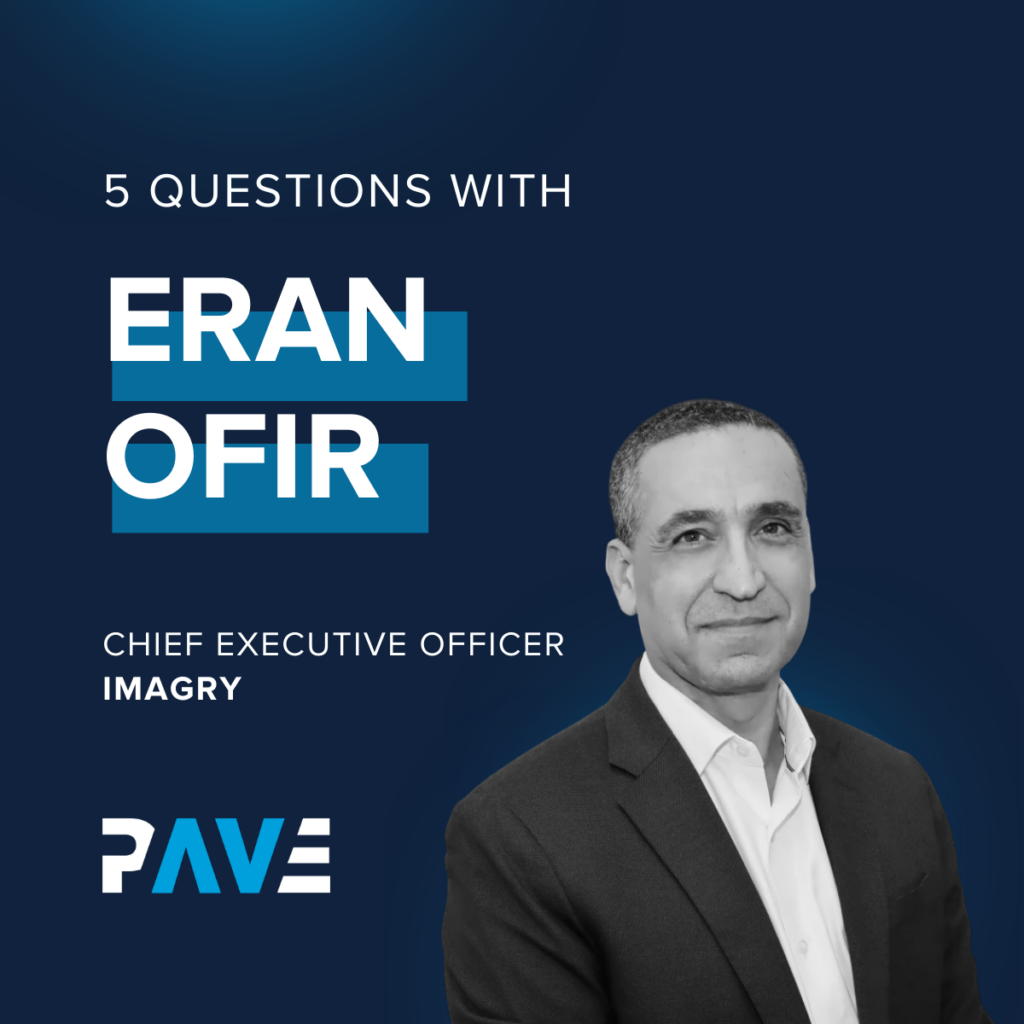
Tell us a little about yourself and your role at Imagry.
I am what you would call “a serial entrepreneur”. I joined Imagry just over four years ago after gaining extensive cross-industry experience in the telecommunications, utilities, retail, and healthcare sectors, while living on four different continents. Some of the businesses that I helped build and manage were acquired by Huawei, NEC, and NCR, after reaching significant commercial scale. As CEO, my role at Imagry is to scale up our field-proven, safe, and cost-effective autonomous driving solutions for the benefit of public transportation operators and car fleets around the world.
Robotaxis are getting a lot of attention, but Imagry is using its autonomous driving technology for something else. Tell us more about your approach.
Robotaxis, while autonomous, often exacerbate congestion by stopping frequently to pick up and drop off 1-2 passengers, creating traffic bottlenecks. In contrast, our autonomous buses can transport up to 40 people at once—dramatically reducing the number of vehicles on the road—and they integrate seamlessly with traffic flow. They pull over to designated stops outside travel lanes, minimizing disruption. Moreover, as cities worldwide introduce congestion taxes and restrict private vehicle access in downtown areas, autonomous public transit is positioned to unlock new efficiencies and relieve gridlock where robotaxis cannot.
Workforce development is a concern for some when it comes to self-driving technology. How do you address the fears of bus drivers and their unions that autonomous buses will take their jobs?
While their concern is understandable, it is not a reflection of reality. Today, there is a worldwide shortage of bus drivers (18% on average, and growing annually), so adding autonomous buses will actually benefit current drivers by providing more freedom to choose their desired shifts and routes. Additionally, due to the slow adoption of regulatory frameworks, mass deployment of autonomous buses will not happen overnight. That said, the shift to autonomous public transportation will happen eventually. The best policy for bus drivers and their unions is to see this as an opportunity to enhance labor conditions by transitioning drivers into “on-board technicians,” “control center operators,” or “customer service ambassadors,” who manage complex software and passenger needs.
When it comes to autonomous public transit in urban areas, many companies are concentrating on pods or shuttles. Why has Imagry chosen to focus on full-size buses?
As I mentioned before, one of the benefits of a standard bus is its larger capacity (up to 40 passengers, versus up to 10 passengers in a pod). Regular buses (“M3-category”) provide fast ROI, something the purpose-built pods failed to do (and subsequently most have disappeared from the market). Not only were they slow (maximum speed of ~15 mph), unable to navigate slopes, and requiring dedicated lanes, but as we have learned from Public Transportation Operators, using standard vehicles that are already familiar to maintenance staff saves them the task of learning new systems and redesigning their depots.
What are the biggest challenges that need to be met when introducing autonomous buses to a new market?
As we saw during the initial deployment of robotaxis, if you don’t have public acceptance, you are creating an unnecessary obstacle. It is very important to get buy-in from the residents, whether or not they plan to use the service. Typically, change (and specifically automation) is more difficult for the older generation, even though they are probably the ones who will benefit most from the new technology. The challenge is to introduce the concept, stressing the safety and reliability aspects, in a way that people will feel comfortable enough to try out the service. This is one of the reasons we partnered with PAVE, since we feel that public education is vital to the success of autonomous vehicle adoption.