
23rd June 2026 – 25th June 2026
Three full-days in Hamburg, Germany. Further practical information will be shared with participants following registration.
Mix of expert presentations, interactive discussions, workshops, and a first-hand experience with an autonomous vehicle.
Early-bird fee: €1650. (30% discount is offered to PAVE Europe Members and Partners).
More information on the cost of the course can be found below.
Certificate of Participation, signed by PAVE Europe, the University of St. Gallen and Beta Mobility.
European cities and regions are under increasing pressure to decarbonise transport, improve accessibility, enhance safety, and use public space more efficiently. At the same time, automated vehicles are moving from experimentation toward early commercial deployment. As the technology is advancing quickly, there is a need to increase knowledge and education on strategic frameworks, governance tools, and practical experience to move beyond pilots and shape automated mobility in the public interest.
Automated Mobility in Practice is a three-day course designed specifically for mobility decision makers, public sector authorities and those responsible for transport and mobility systems. Developed by PAVE Europe, the Institute for Mobility at the University of St. Gallen, and Beta Mobility, the course equips participants with the knowledge, tools, and hands-on insight needed to turn automated mobility from a technological experiment into a scalable, publicly beneficial service.
Rather than focusing on the technology alone, the course treats automated mobility as a strategic and governance challenge. It supports mobility-decision makers in clarifying what they want automated mobility to achieve, how to steer markets toward those outcomes, and what role they should play in a rapidly changing mobility value chain.
This course is accepting a maximum of 25 participants, and spaces will be allocated on a first-come, first-served basis. For any queries, please contact [email protected].
The advancement of autonomous vehicles blurs traditional boundaries between public transport, shared mobility, and private cars. Without clear public direction, they risk reinforcing car dependency and inequitable access. With the right governance, however, they can help cities and regions move more people with fewer vehicles, reduce emissions, and improve accessibility.
This course will address three critical gaps facing public authorities:
How automated mobility can interact with existing transport frameworks and where governance structures need to evolve
How to define societal goals and use policy tools to steer private investment toward public benefit
How to position public authorities as regulators, orchestrators or purchasers within the emerging automated mobility value chain
This course is designed mobility decision makers, public sector representatives, authorities, and practitioners of transport and mobility systems, including:

Though the course is designed for this specific group, we do welcome industry representatives, researchers, or consultants who would like to have a better understanding of the autonomous mobility ecosystem.
By the end of the programme, participants will leave with:
Ahead of the programme, each participant is asked to prepare a short individual assignment describing a real automated mobility challenge in their city or region.
Participants will outline:
This challenge will serve as a reference point throughout the course and will be revisited during workshops and the final action-planning session.
Objective: establish a common understanding of the automated mobility landscape and its implications for existing transport systems and structures.
Formats include expert presentations, guided discussions, and interactive sessions.
Objective: equip all participants with frameworks and tools to set direction and actively shape automated mobility outcomes.
This day combines presentations with breakout work, scenario exercises and peer exchange.
Objective: Translate strategy into practice through direct exposure to an operational automated mobility service.
Fees per participant
The course fee depends on the time of registration:
Early-bird rate: €1,650 (until 15th March)
Standard rate: €1,950 (until 1st June)
Late registration: €2,250 (until 19th June)
The applicable rate is determined by the date of registration and invoicing. All fees are stated exclusive of VAT, where applicable.
What the fee includes
The course fee covers:
Participation in the full three-day course
All course materials and documentation
Refreshments and lunches during the course
The organised study visit and test rides
Access to the participant peer network after the course
Payment and Confirmation
After submitting the registration form, participants will receive an invoice by email.
Participation to the Automated Mobility in Practice Course is assured only upon receipt of course fee stated in the invoice by the deadline.
Due to the limited number of places, registrations that are not paid by the deadline on the invoice will be released and offered to other applicants. Please read our terms and conditions carefully before registration.
PAVE Europe Member Discount
PAVE members receive a 30 % discount on the applicable course fee (early-bird, standard, or late rate, depending on the time of registration).
Capacity
The course is limited to 25 participants to ensure a high level of interaction and exchange.
Questions
For questions related to fees, invoicing, or eligibility for the PAVE Europe member discount, please contact
[email protected].
Participation is limited to 25 places to ensure a high-quality learning experience and meaningful peer exchange.
Application process:
Please read our terms and conditions carefully before registering for the course.
Dates: 23rd – 25th June 2026
Location: Hamburg, Germany
Language: English
Should you have any questions, please check the FAQs section below, or email us at [email protected].
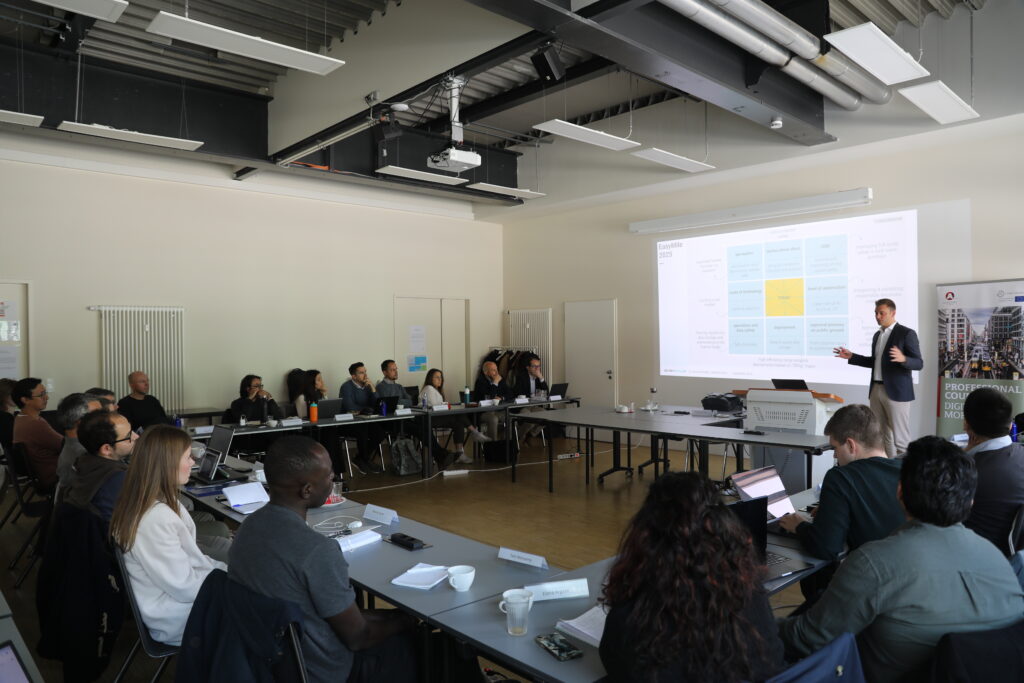
The course is designed for public-sector professionals with responsibilities in transport and mobility governance. This includes staff from ministries, transport authorities, public transport authorities and operators, city and regional governments, and related public bodies.
Applicants should have a role that allows them to influence strategy, regulation, procurement, or deployment decisions.
Participants do not need a technical or engineering background. The course is focused on strategy, governance, and public-sector decision-making, not vehicle engineering or software development.
Applications are submitted via the online registration form linked on this page. Once you have completed the form, you will receive an invoice by email. Your place is confirmed only after payment has been received.
After payment, participants will receive a confirmation email with further practical details, including the pre-course assignment, agenda updates, and logistical information.
The course is conducted entirely in English. Participants should have an English proficiency of at least B2 level to fully engage in discussions and group work.
No, the fee does not include accommodation and transport costs.
For any questions regarding eligibility, registration, or payment, please contact [email protected].
This course is developed and delivered by PAVE Europe, Instiute for Mobility, Universtiy of St. Gallen, and Beta Mobility.
About PAVE Europe
Partners for Automated Vehicle Education Europe (PAVE Europe) is a non-profit coalition that seeks to raise the level of public knowledge of automated vehicle technology and the potential benefits for safety, mobility, equity, and congestion. PAVE Europe’s diverse membership includes international corporations, start-ups, consumer advocates, nonprofit groups, and other stakeholders. PAVE Europe seeks to educate and facilitate dialogue among industry, policymakers, and the public to advance the development and deployment of AV technology.
About Institute for Mobility at the University of St. Gallen (HSG)
At the Institute for Mobility at the University of St. Gallen (IMO-HSG) we aim to make a meaningful contribution to sustainable, social, and economic improvements in mobility. The Institute for Mobility at the University of St.Gallen (IMO-HSG) was established precisely for this purpose. Founded in 2021 the institute builds upon 20+ years of academic excellence in customer insight. Over 20+ senior researchers, visiting scholars, and external experts combine their expertise to explore the future of mobility across 3 disciplines — science, economics, and politics. By following a behavioral research approach, we want to contribute to a future of mobility that is environmentally, socially, and economically sustainable.
About Beta Mobility
Beta Mobility is a Nordic advisory working solely with mobility. Beta helps cities, transport authorities, startups, and mobility operators turn strategic ambition into operational reality. Most mobility strategies fail at execution. Beta specializes in closing that gap: translating ambition into market strategies, system designs, and regulatory frameworks that work across commercial models, operational realities, and public requirements. With experience scaling mobility companies across Europe and deep industry networks, Beta brings both strategic thinking and operational know-how. From autonomous transport to shared mobility and urban logistics, the focus is making future mobility work in practice, not just on paper.